Train With Your Body Clock, Not Against it.
Most athletes track their sleep in hours. Eight hours and you feel good. Six and you don't. But duration is only half the equation — and arguably the less important half.
Sleep deprivation doesn't just make you tired. It directly collapses the circadian curve that governs your physical peak — flattening core body temperature, blunting hormone release, and eroding the precise physiological window where your body is capable of its best output. A 2020 study using Olympic swimming data put a number on what that window is worth. The results are difficult to ignore.
The data
What Olympic swimming tells us
A 2020 study published in Scientific Reports analyzed Olympic swim times across four Games (2004–2016). After controlling for individual ability and race type, one variable stood out clearly: time of day.

The mechanism behind this window isn't mysterious. It tracks directly with core body temperature (CBT) — which rises steadily through the day and peaks around 7 PM. Warmer muscles contract more forcefully, nerves conduct faster, and enzyme reactions accelerate. The body is simply more capable in the late afternoon than in the morning. But only if the circadian system is intact.

This is fundamentally different from cognitive performance, where the picture is more complex. For physical output, CBT is the dominant driver — which is why the athletic peak is consistent, measurable, and tied to a specific time window rather than task type.
The nuance
Chronotype matters more than the average
The 5 PM peak is a population average. Your individual peak depends on your chronotype — your inherited biological tendency toward being a morning type (lark) or evening type (owl).
Early chronotypes may peak closer to 3 PM. Late chronotypes may not reach their ceiling until 7–8 PM. The practical implication: if you're a lark competing or training at 7 PM, you're not necessarily at peak performance — you may have already passed it.
The threat
Sleep deprivation doesn't just make you tired — it flattens your peak
This is where most athletes misunderstand the relationship between sleep and performance. The assumption is that sleep loss costs you energy. That's true — but the deeper cost is what it does to the circadian curve itself.
When you're sleep deprived, the amplitude of your CBT rhythm shrinks. The trough stays higher, and the peak comes lower. The result isn't just a flat feeling — it's a physiologically flatter day. The late-afternoon performance advantage documented in the Olympic study depends on a well-functioning circadian system to exist at all. Chronic under-sleep can effectively erase it.

The numbers above are illustrative, not from a single study — but they reflect a consistent pattern in the literature: sleep deprivation costs you more at your peak than at your trough, because there's more to lose. A 30% reduction in peak capacity is a far bigger athletic problem than a 10% reduction in your morning baseline.
The impact of sleep on performance is not just about fatigue. It is about whether the circadian system can generate the physiological conditions that peak performance depends on.
The overlooked variable
Sleep timing matters as much as sleep duration
Here's the finding most athletes never act on: going to bed late and sleeping eight hours is not the same as going to bed early and sleeping eight hours. Total duration may be identical. But the circadian consequences are not.
Your body's rhythms — CBT, cortisol, melatonin, growth hormone — are anchored to your habitual sleep-wake timing, not to a fixed clock. Shift your sleep window later and your entire circadian phase shifts with it. The peak that once fell at 5 PM now falls at 7 or 8 PM. In theory that sounds fine — but in practice, most athletes compete and train on fixed schedules that don't move with their displaced biology.
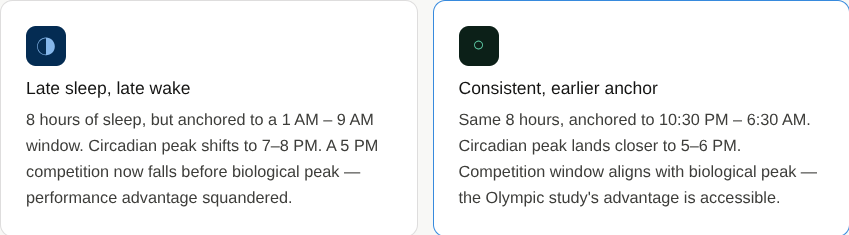
This is why sleep hygiene advice that focuses only on "get eight hours" misses the point for athletes. Consistency of timing — particularly a consistent wake time — is what keeps the circadian system calibrated. Even one or two nights of dramatically shifted sleep timing (the weekend effect) can displace the circadian phase enough to affect the following week's performance.
Applied
Applying this Data to Optimise your Physical Capabilities
Anchor your wake time, not your bedtime The circadian clock is set primarily by light exposure at wake time. Fix your wake time to within 30 minutes every day — including weekends. Bedtime will follow naturally as sleep pressure builds. This single habit does more for circadian alignment than almost anything else.
Treat "social jetlag" as a real training variable Sleeping two hours later on weekends than weekdays creates the equivalent of flying two time zones every Friday night and back every Monday morning. Research links social jetlag to measurably worse athletic output during the following week. Schedule it like you would actual travel disruption.
Schedule your peak sessions in the late afternoon Reserve your highest-intensity training — threshold efforts, heavy lifts, time trials — for the 3–7 PM window where CBT and neuromuscular performance are highest. Morning sessions build the base; afternoon sessions test the ceiling.
If you must compete in the morning, shift your sleep window gradually Move your sleep and wake times 30 minutes earlier every two days in the week before a morning competition. This shifts your circadian phase forward so your biological peak arrives earlier. Don't try to do this the night before — it takes days to move.
Protect sleep duration — but prioritise timing first Eight hours at a consistent time beats seven hours at an irregular time, which beats nine hours with a two-hour phase shift. If you can only fix one thing, fix when you sleep before worrying about how long.
The Olympic data makes the stakes concrete: time of day exceeded the margin between gold and silver in 40% of finals. Most of that advantage lives or dies in the weeks of sleep timing that precede the event — not the night before, and not just the number of hours logged.
Sleep duration is the variable athletes know to track. Sleep timing is the variable that determines whether any of it pays off.
Sources: Lok et al. (2020), Scientific Reports / Nature — Olympic swim time analysis 2004–2016. Supporting literature: Walker (2017), Why We Sleep; Wittmann et al. (2006), social jetlag research, Chronobiology International; Dijk & Czeisler (1994), CBT and circadian amplitude, Journal of Physiology.


Comments